Comparing Local LLMs in 2026: Which One Should You Choose Among Llama, Mistral, Phi, and Gemma?
Explore the traits of four major open-weight model families running on laptops and browsers, plus key factors for on-device deployment.
Until quite recently, running a usable Large Language Model (LLM) required expensive cloud servers or costly API fees. However, as of 2026, the trend has completely shifted. Today, "open-weight models" that run independently on personal laptops or even lightweight web browsers are dominating the market.
For those considering the adoption of local AI due to security or cost concerns, we clearly break down the actual characteristics of the "Big Four" currently dominating the on-device ecosystem (Llama, Mistral, Phi, Gemma) and provide clear criteria for choosing the model that best fits your environment.
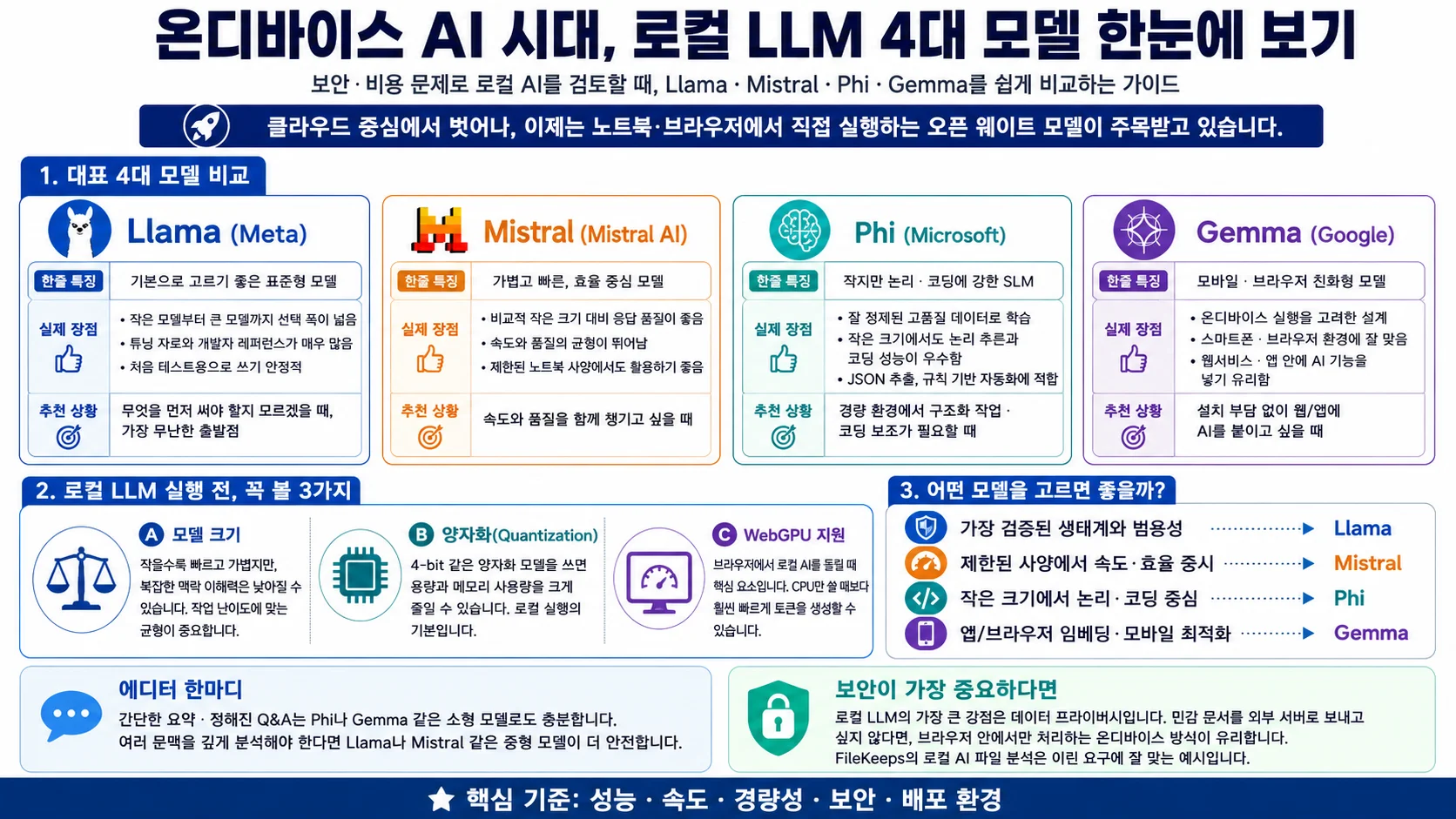
1. Honest Reviews of the Big Four AI Families Running on Your Device
🦙 Llama (Meta) — "The Textbook of Open-Source AI, the Fail-Safe Default"
Led by Meta, Llama is the very force that created the local LLM ecosystem.
- Practical Characteristics: It boasts the most comprehensive lineup ranging from ultra-small to large models, and the amount of tuning materials and reference guides created by developers worldwide is overwhelming.
- Selection Criteria: The most natural and stable foundational skeleton to test out first when you are unsure of what to choose.
💨 Mistral (Mistral AI) — "The Ultimate in Cost-Effectiveness and Speed"
Created by Europe's rising AI star, Mistral AI, this model focuses on efficiency.
- Practical Characteristics: The physical size (parameters) of the model is small, but when you run it, the response quality is remarkably high. It runs lightly while maintaining fast speeds.
- Selection Criteria: The first model to consider when you want to achieve both speed and answer quality in a laptop environment with limited hardware specs.
🔬 Phi (Microsoft) — "Small but Mighty, the King of Logic and Coding"
This is the representative Small Language Model (SLM) introduced by Microsoft.
- Practical Characteristics: Instead of scattered internet data, it was trained exclusively on carefully curated, high-quality textbook-level data. As a result, despite being small enough to fit on a smartphone, it solves coding and logical reasoning problems much more intelligently than most medium-sized models.
- Selection Criteria: Ideal for extracting structured data (such as JSON) in lightweight environments or automating strict rule-based tasks.
💎 Gemma (Google) — "A Model Born for Mobile and Browsers"
This is an open model family infused with Google's latest deep learning technology.
- Practical Characteristics: Designed from the ground up targeting on-device environments operating inside smartphones or web browsers. Because it efficiently divides and utilizes device memory, it runs smoothly without lagging even on mobile environments.
- Selection Criteria: Advantageous when you want to implement a standalone AI feature within your web service or mobile app screen that users can operate immediately without any separate installation.
2. Practical Tips to Keep in Mind When Running on Laptops or Browsers
Unlike cloud AI, local models that must use your computer's own resources require you to account for hardware limitations. You only need to keep these three things in mind:
- Model Size: Naturally, smaller sizes are lighter and faster, but their ability to understand complex contexts decreases accordingly. You must find a compromise tailored to the difficulty of your tasks.
- Quantization: A technique that puts the model on a diet by compressing its bulk into 4-bit or similar formats. Using a model that has undergone this quantization process is essential for running AI locally. It dramatically reduces capacity and memory consumption.
- WebGPU Support: This is the core factor when running local AI in a web browser environment. While calculating solely with the CPU makes speeds crawl, utilizing WebGPU technology—which directly leverages the graphics card—makes token generation speeds dozens of times faster.
💡 At-a-Glance Local LLM Matching Guide
- Need the most verified ecosystem and smooth versatility? ➔ Llama
- Need high speed and efficiency under limited specifications? ➔ Mistral
- Need meticulous logical operations or coding in a small size? ➔ Phi
- Need app or browser embedding with mobile optimization? ➔ Gemma
Editor's One-Line Advice For lightweight tasks such as simple text summarization or fixed Q&A, setting up lightweight small models like Phi or Gemma is the way to reduce the burden on your device. On the other hand, for deeper tasks that require analyzing complex, interwoven contexts, choosing a medium model or higher from the Llama or Mistral families—even if slightly heavier—is safer in terms of results.
🔒 Zero External Leaks: If You Need Absolute Security
The most fundamental reason why companies and individuals pay attention to local LLMs is ultimately data privacy. If you want to analyze sensitive documents without sending even a single byte of data to external cloud servers, summarizing and processing them exclusively inside your secure web browser (Sandbox), FileKeeps' local AI file analysis feature, which adheres strictly to the on-device principle, will be your most reliable alternative.
FileKeeps' AI file analysis runs these local models right inside your browser. Try On-Device AI →