Is It Safe to Upload Files to AI? Why Privacy Laws Matter
How privacy regulations constrain AI service design and why local, zero-transfer processing is a powerful solution.
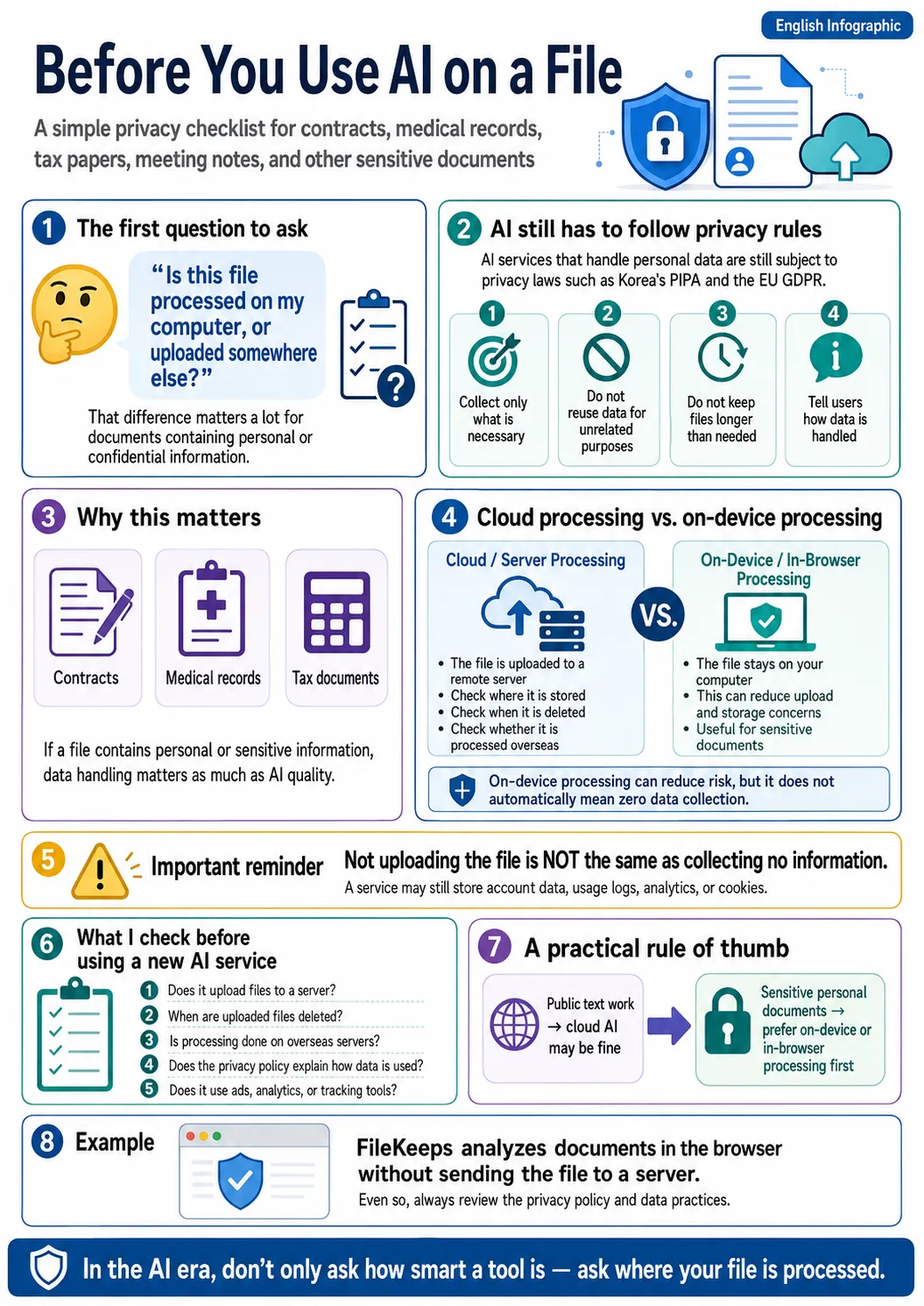
When using AI, we all run into moments like this at least once: "Please summarize this contract." "Please organize these meeting minutes." "Please translate this PDF." Since the results come out in just a few seconds, it is incredibly convenient. However, every time I use AI, I check one thing first: "Is this file being processed right here on my computer, or is it being uploaded somewhere?" This distinction matters much more than you might think. This is especially true if the files contain personal information, such as company documents, medical records, or tax-related paperwork.
AI cannot escape privacy laws either
Sometimes, people think AI services are exempt from existing laws.
But that is not the case.
Because AI is ultimately a service that processes human data, it must comply with regulations like South Korea's Personal Information Protection Act (PIPA) or Europe's GDPR.
You don't need to memorize the legal articles, but knowing the standards by which your personal information is handled will help you choose your services wisely.
The principles are simpler than you think
Any service that handles personal information should generally follow these principles: First, it should only collect necessary information. If it is a document summarization service, it only needs to process the information required for the summary. Collecting unnecessary details like names or resident registration numbers is not recommended. Second, it must not be used for other purposes. If a user uploads a document to translate it, using that data for other purposes can cause problems. Third, it should not be kept longer than necessary. If files remain on the server for months or years even after the task is finished, the risks increase accordingly. And finally, users must be informed. You should be able to easily check where your file is processed, how long it is kept, and who it is shared with.
That is why I check this when using AI services
In the past, I used to pick services based solely on their features. Nowadays, however, I look for one more thing: "Is it a method where files are uploaded to a server?" Most AI services process uploaded files on their servers. That in itself isn't a bad thing. However, from that moment on, I also check details like where the file is stored, when it is deleted, and whether overseas servers are used. I pay even closer attention, especially if the files contain corporate documents or personal information.
This is also why On-Device AI is gaining attention
Recently, services that process files within your browser or computer rather than sending them to a server have been steadily increasing. For example, even if you summarize a resident registration certificate or a contract, the file itself never leaves your computer. Since there's no need to send it to a server, you can reduce worries that might arise during the storage or transmission process. Of course, that doesn't mean all problems are solved.
Not sending files isn't the end of the story
Many people get confused about this point. Even if files are not sent to a server, it is entirely possible that a service stores account information, analyzes browsing history, or uses advertising cookies. In other words, not uploading files and not collecting any information do not mean the same thing. That is why it is a good idea to read the privacy policy at least once. It contains quite a few important details, much more than you might expect.
When using AI services, I only check these things
You don't need to study complex laws. Instead, checking just the following when using a new AI service is more than enough:
- Whether files are uploaded to a server
- When uploaded files are deleted
- Whether they are processed on overseas servers
- Whether the data usage methods are described in the privacy policy
- Whether advertising or analytics tools are used alongside the service
Taking just a few minutes to check these can help you decide which services you can use with peace of mind.
In the AI era, there is something more important than performance
In the past, we only looked at how smart an AI was. Now, however, we have entered an era where we must also look at how it handles our data. AI performance is becoming increasingly similar. On the other hand, once personal information is leaked, it is difficult to reverse. That is why, whenever I use a new AI service, I check **"Where is my file processed?"** before looking at its features. I believe this one small habit is the most realistic way to protect your personal information.
FileKeeps analyzes documents right inside your browser without sending them to a server. Analyze without uploading files →